
ISBN:
9780443278877
Copyright:
2027
Publication Date:
02-09-2026
Page Count:
364
Imprint:
Elsevier
List Price:
$67.99

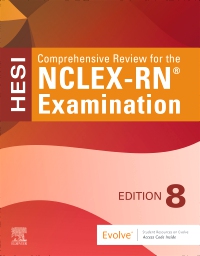
Comprehensive Review for the NCLEX-RN® Examination - Elsevier E-Book on VitalSource, 8th Edition
by HESI and Denise M. Korniewicz, PhD, RN, FAAN
Elsevier eBook on VitalSource
ISBN:
9780443278877
Copyright:
2027
Publication Date:
02-09-2026
Page Count:
364
Imprint:
Elsevier
List Price:
$67.99
Was
$67.99
Now $61.19
Or $0.00 with a valid access code
Prepare for success on the NCLEX-RN® exam with this proven HESI® review! Comprehensive Review for the NCLEX-RN® Examination, 8th Edition provides a complete, all-in-one guide to the information you need to know. Using an easy-to-read outline format, this book reviews content by nursing concepts and clinical areas. Along the way, valuable tips from HESI help you develop clinical judgment and critical thinking skills in real-life clinical situations. With 1,200 review questions on the companion Evolve website, you can practice test-taking in the same electronic format you will experience on nursing school exit exams and on the Next-Generation NCLEX-RN exam.
-
- NEW! Thoroughly updated content incorporates clinical updates and reflects the latest NCLEX-RN® test plan
- NEW! Questions with reference ranges mirror nursing practice more authentically and increase clinical judgment
-
- 1,200 NCLEX® practice questions on the companion Evolve website include alternate item formats to provide a testing experience similar to the HESI Exit and NCLEX® exams
- Chapters organized by clinical area enable you to easily search for various topics to review
- HESI Hint boxes spotlight important clinical information and concepts commonly tested on the NCLEX-RN® exam
- Clinical Judgment study questions (with rationales) reinforce key concepts and content
- Fill-in-the-blank and prioritizing questions mirror the alternate item format item types included on the NCLEX-RN® exam
- Pharmacology tables highlight the need-to-know drug therapy content emphasized on the NCLEX-RN® exam
- Consistent format makes it easy to move between topics when reviewing
-
1 Introduction to Test-Taking Strategies and the NGN-NCLEX-RN
Test-Taking Strategies
The Next-Generation NCLEX-RN Examination
Job Analysis Studies
NGN-NCLEX Clinical Judgment Model
Next-Generation NCLEX-RN Computer-Adaptive Testing
General Principles to Remember About Taking Tests
Test-Taking Skills
2 Leadership and Management
Leaders Versus Managers
Maintaining a Safe Effective Work Environment
Legal and Ethical Issues Influencing Nursing
Review of Legal Aspects of Nursing
Disaster Nursing and Crisis Intervention
Review of Disaster Nursing
3 Advanced Clinical Concepts
Respiratory Failure
Shock
Disseminated Intravascular Coagulation
Resuscitation
Management of Foreign-Body Airway Obstruction
Fluid and Electrolyte Balance
Electrolyte Imbalance
Determining Acid-Base Disorders
Electrocardiogram
Perioperative Care
HIV Infection
Pediatric HIV Infection
Pain
Death and Grief
4 Medical-Surgical Nursing
Communication
Health Promotion and Disease Prevention
Teaching/Learning
Spiritual Assessment
Cultural Diversity
Complementary and Alternative Interventions
Respiratory System
Renal System
Cardiovascular System
Gastrointestinal Reflux Disease GERD
Endocrine System
Musculoskeletal System
Neurosensory System
Neurologic System
Hematology and Oncology
Reproductive System
Burns
5 Pediatric Nursing
Growth and Development
Pain Assessment and Management in the Pediatric Client
Respiratory Disorders
Cardiovascular Disorders
Care of Children With Congenital Heart Disease
Neuromuscular Disorders
Renal Disorders
Gastrointestinal Disorders
Hematologic Disorders
Metabolic and Endocrine Disorders
Skeletal Disorders
6 Maternity Nursing
The Menstrual Cycle
Conception and Pregnancy
Psychosocial Responses to Pregnancy
Prenatal Nutrition
Antepartum Fetal and Maternal Assessments
Chorionic Villi Sampling
Amniocentesis
Antepartum Complications
Gravidarum
Abruptio Placentae and Placenta Previa
Hypertensive Disorders of Pregnancy
Intrapartum Nursing Care
Electronic Fetal Monitoring
Labor and Birth Complications
Normal Puerperium Postpartum
Postpartum Complications
The Normal Newborn
Newborn Complications
Preterm Newborn
Respiratory Distress Syndrome
Effects of Substance Abuse on Neonate
Review of Anatomy and Physiology of Reproduction and Antepartum Nursing Care
Review of Fetal and Maternal Assessment Techniques
Review of Antepartum Complications
Review of Intrapartum Nursing Care
Review of Normal Puerperium Postpartum
Review of Postpartum Complications
Review of the Normal Newborn
Review of Substance Abuse Disorder
7 Psychiatric Nursing
Nursing Interventions
Therapeutic Treatment Modalities
Alcohol Withdrawal Syndrome
Opioid Withdrawal
8 Gerontologic Nursing
Theories of Aging
Communication
Aging and its Effect on Body Systems
Appendix Common Laboratory Tests
Index -
-
Ways of Reading
- The appearance of the text and page layout can be modified according to the capabilities of the reading system (font family and font size, spaces between paragraphs, sentences, words, and letters, as well as color of background and text)
- This e-publication is accessible to the full extent that the file format and types of content allow, on a specific reading device, by default, without necessarily including any additions such as textual descriptions of images or enhanced navigation
- All content can be read as read aloud speech or dynamic braille
-
Conformance
- The certifier's credential is https://bornaccessible.benetech.org/certified-publishers/
- For detailed accessibility information, see Elsevier's website at https://www-elsevier-com.ucc.idm.oclc.org/about/accessibility
- For queries regarding accessibility information, contact [email protected]
- The publication was certified on 11-02-2026
-
Navigation
- Table of contents to all chapters of the text via links
- Page list to go to pages from the print source version
-
Rich Content
- No information is available
-
Hazards
- No information is available
-
Product Content
- No information is available
-
Legal Considerations
- No information is available
-
Additional Accessibility Information
- Content is enhanced with ARIA roles to optimize organization and facilitate navigation
- Page breaks included from the original print source
- For readers with color vision deficiency, use of color (e.g., in diagrams, graphics and charts, in prompts, or on buttons inviting a response) is not the sole means of graphical distinction or of conveying information
- The body text is presented with a contrast ratio of at least 4.5:1 (or 3:1 for large/heading text)
- Ultra-high contrast between text and background
- E-publication includes basic navigation (usually less detailed than TOC-based navigation)
- Where links, controls or buttons are included in the content, the purpose or functionality of each link, control or button is apparent from the associated text alone - or where it is unclear, separate link, control or button descriptions are provided
- All (or substantially all) textual matter is arranged in a single logical reading order (including text that is visually presented as separate from the main text flow, e.g., in boxouts, captions, tables, footnotes, endnotes, citations, etc.). Non-textual content is also linked from within this logical reading order. (Purely decorative non-text content can be ignored).
- Where interactive content is included in the product, controls are provided (e.g., for speed, pause and resume, reset) and labelled to make their use clear.
- The language of the text has been specified (e.g., via the HTML or XML lang attribute) to optimise text-to-speech (and other alternative renderings), both at the whole document level and, where appropriate, for individual words, phrases or passages in a different language.
-
Ways of Reading

Was
$67.99
Now $61.19
Or $0.00 with a valid access code

 as described in our