
ISBN:
9780443106583
Copyright:
2023
Publication Date:
09-07-2022
Page Count:
864
Imprint:
Saunders
List Price:
$50.99

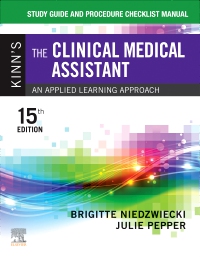
Study Guide and Procedure Checklist Manual for Kinn's The Clinical Medical Assistant - Elsevier eBook on VitalSource, 15th Edition
by Brigitte Niedzwiecki, RN, MSN, RMA and Julie Pepper, BS, CMA (AAMA)
Elsevier eBook on VitalSource
ISBN:
9780443106583
Copyright:
2023
Publication Date:
09-07-2022
Page Count:
864
Imprint:
Saunders
List Price:
$50.99
Was
$50.99
Now $44.87
Or $0.00 with a valid access code
Designed to support the trusted content in Kinn’s The Clinical Medical Assistant, 15th Edition, this study guide is an essential review and practice companion to reinforce key concepts, encourage critical thinking, and help you apply medical assisting content. This robust companion guide offers a wide range of activities to strengthen your understanding of common clinical skills — including certification preparation questions, a review of medical terminology and anatomy, and application exercises. Trusted for more than 65 years as a key part of the journey from classroom to career, it also features competency checklists to accurately measure your progress and performance from day one until you land your first job as a medical assistant.
-
- NEW! Content aligns to 2022 medical assisting educational competencies
- NEW! Advanced Clinical Skills unit features three new chapters on IV therapy, radiology basics, and radiology positioning to support expanded medical assisting functions
- NEW! Coverage of telemedicine, enhanced infection control related to COVID-19, and catheterization
- NEW! Procedures address IV therapy, limited-scope radiography, applying a sling, and coaching for stool collection
- EXPANDED! Information on physical medicine and rehabilitation
- EXPANDED! Content on specimen collection, including wound swab, nasal, and nasopharyngeal collections
-
- Comprehensive coverage of all clinical procedures complies with accreditation requirements
- Approximately 135 step-by-step procedure checklists enable you to assess and track your performance for every procedure included in the textbook
- Chapter-by-chapter correlation with the textbook allows you to easily follow core textbook competencies
- Matching and acronym activities reinforce your understanding of medical terminology, anatomy and physiology, and chapter vocabulary
- Short-answer and fill-in-the-blank exercises strengthen your comprehension of key concepts
- Multiple-choice questions help you prepare for classroom and board exams
- Workplace application exercises promote critical thinking and job readiness before you enter practice
- Internet exercises offer ideas for expanded and project-based learning
-
-
 Kinn's The Clinical Medical Assistant - Elsevier eBook on VitalSourceElsevier eBook on VitalSource
 -
 Kinn's The Clinical Medical AssistantPaperback
 -
 Kinn's The Clinical Medical Assistant - Binder ReadyBinder Ready
-
-
1. The Professional Medical Assistant and the Healthcare Team
2. Health Records
3. Introduction to Medical Terminology and Anatomy
4. Infection Control
5. Vital Signs
6. Physical Examination
7. Patient Coaching
8. Nutrition and Health Promotion
9. Surgical Supplies and Instruments
10. Assisting with Surgical Procedures
11. Principles of Electrocardiography
12. Medical Emergencies
13. Principles of Pharmacology
14. Pharmacology Math
15. Administering Medications
16. Ophthalmology and Otolaryngology
17. Dermatology
18. Allergy and Infectious Disease
19. Gastroenterology
20. Orthopedics and Rheumatology
21. Physical Medicine and Rehabilitation
22. Neurology
23. Behavioral Health
24. Endocrinology
25. Cardiology
26. Pulmonology
27. Urology and Male Reproduction
28. Obstetrics and Gynecology
29. Pediatrics
30. Geriatrics
31. Introduction to the Clinical Laboratory
32. Urinalysis
33. Blood Collection
34. Analysis of Blood
35. Microbiology and Immunology
36. Intravenous Therapy
37. Radiology Basics
38. Positioning for Radiology
39. Skills and Strategies -
-
Ways of Reading
- The appearance of the text and page layout can be modified according to the capabilities of the reading system (font family and font size, spaces between paragraphs, sentences, words, and letters, as well as color of background and text)
- This e-publication is accessible to the full extent that the file format and types of content allow, on a specific reading device, by default, without necessarily including any additions such as textual descriptions of images or enhanced navigation
- No information about nonvisual reading is available
-
Conformance
- For detailed accessibility information, see Elsevier's website at https://www-elsevier-com.ucc.idm.oclc.org/about/accessibility
- For queries regarding accessibility information, contact [email protected]
- The publication was certified on 03-11-2025
-
Navigation
- Table of contents to all chapters of the text via links
-
Rich Content
- No information is available
-
Hazards
- No information is available
-
Product Content
- No information is available
-
Legal Considerations
- No information is available
-
Additional Accessibility Information
- For readers with color vision deficiency, use of color (e.g., in diagrams, graphics and charts, in prompts, or on buttons inviting a response) is not the sole means of graphical distinction or of conveying information
- E-publication includes basic navigation (usually less detailed than TOC-based navigation)
- Where links, controls or buttons are included in the content, the purpose or functionality of each link, control or button is apparent from the associated text alone - or where it is unclear, separate link, control or button descriptions are provided
- All (or substantially all) textual matter is arranged in a single logical reading order (including text that is visually presented as separate from the main text flow, e.g., in boxouts, captions, tables, footnotes, endnotes, citations, etc.). Non-textual content is also linked from within this logical reading order. (Purely decorative non-text content can be ignored).
- The language of the text has been specified (e.g., via the HTML or XML lang attribute) to optimise text-to-speech (and other alternative renderings), both at the whole document level and, where appropriate, for individual words, phrases or passages in a different language.
-
Ways of Reading
Was
$50.99
Now $44.87
Or $0.00 with a valid access code

 as described in our