
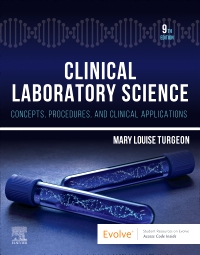

Clinical Laboratory Science - Elsevier eBook on VitalSource, 9th Edition
Elsevier eBook on VitalSource
Now $88.87
**Selected for Doody’s Core Titles® 2024 in Laboratory Technology**
Using a discipline-by-discipline approach, Turgeon’s Clinical Laboratory Science: Concepts, Procedures, and Clinical Applications, 9th Edition, provides a fundamental overview of the concepts, procedures, and clinical applications essential for working in a clinical laboratory and performing routine clinical lab tests. Coverage includes basic laboratory techniques and key topics such as safety, phlebotomy, quality assessment, automation, and point-of-care testing, as well as discussion of clinical laboratory specialties. Clear, straightforward instructions simplify laboratory procedures and are guided by the latest practices and CLSI (Clinical and Laboratory Standards Institute) standards. Written by well-known CLS educator Mary Louise Turgeon, this edition offers essential guidance and recommendations for today’s laboratory testing methods and clinical applications.
-
- NEW! Content spans traditional principles and practices to the expanding applications of molecular diagnostics that reflect the most current clinical laboratory practices and technology
- NEW! New Frontiers in Molecular Diagnostics chapter explores the future of the field
- NEW! Coverage of the "new face" of clinical laboratory practice recognizes of the important need for laboratories for SARS-CoV-2 testing during the COVID-19 pandemic, with an increased emphasis on safety, patient considerations, and delivery of testing modes
- NEW! Exploration of current laboratory safety issues, strategies, and the need for various safety-related officers to control problems such as supply chain interruptions and the risk of infection from aerosols
- NEW! Applications of innovative quality models, such as clinical outcomes and biological variation, improve the acceptable standards of laboratory testing and the interpretations of reference ranges
- NEW! Expanded information on new oral anticoagulants is presented along with the appropriate laboratory testing, with alternative testing added to the discussion of blood coagulation
- NEW! Increased focus on cell types in cerebrospinal fluid includes descriptions of associated clinical disorders and microbial examination
- NEW! Expanded comparisons of the characteristics of important body fluids, such as synovial fluid, serous fluids, seminal fluid, and amniotic fluid.
- NEW! Appendix offers comprehensive overview of COVID-19
-
- Broad scope of coverage makes this text an ideal companion for clinical laboratory science programs at various levels, including CLS/MT, CLT/MLT, medical laboratory assistant, and medical assisting, and reflects the taxonomy levels of the CLS/MT and CLT/MLT exams
- Detailed procedure guides and procedure worksheets on Evolve and in the ebook familiarize you with the exact steps performed in the lab
- Vivid, full-color illustrations depict concepts and applicable images that can be seen under the microscope
- An extensive number of certification-style, multiple-choice review questions are organized and coordinated under major topical headings at the end of each chapter to help you assess your understanding and identify areas requiring additional study.
- Case studies include critical thinking group discussion questions, providing the opportunity to apply content to real-life scenarios
- The newest Entry Level Curriculum Updates for workforce entry, published by the American Society for Clinical Laboratory Science (ASCLS) and the American Society for Clinical Pathology (ASCP) Board of Certification Exam Content Outlines, serve as content reference sources
- Convenient glossary makes it easy to look up definitions without having to search through each chapter
- An Evolve companion website provides convenient access to animations, flash card sets, and additional review questions
- Experienced author, speaker, and educator Mary L. Turgeon is well known for providing insight into the rapidly changing field of clinical laboratory science
-
Part I Basic Laboratory Techniques
1. Fundamentals of the Clinical Laboratory
2. Safety: Patient and Clinical Laboratory Practices
3. Quality Assessment and Quality Control in the Clinical Laboratory
4. The Microscope
5. Systems of Measurement, Laboratory Equipment, and Reagents
6. Laboratory Mathematics and Solution Preparation
7. Basic and Contemporary Techniques in the Clinical Laboratory
8. Laboratory Testing: From Point of Care to Total Automation
Part II Basic Clinical Laboratory Specializations
9. Phlebotomy: Collecting and Processing Patient Blood Specimens
10. An Introduction to the Principles and Practice of Clinical Hematology
11. Hemostasis and Blood Coagulation
12. Renal Physiology and Urinalysis
13. Examination of Body Fluids and Miscellaneous Specimens
14. Introduction to the Principles and Practice of Clinical Chemistry
15. New Frontiers in Molecular Diagnostics
16. Introduction to Medical Microbiology
17. Immunology and Serology
18. Immunohematology and Transfusion Medicine
Appendix
A: Answers to Review Questions and Case Studies
B: AMA Recognized Disease/Organ Panels
C: Periodic Table
D: Overview of COVID-19
E: Molecular Testing Methods
F Quick Calculations and Adult Reference Values -
-
Ways of Reading
- The appearance of the text and page layout can be modified according to the capabilities of the reading system (font family and font size, spaces between paragraphs, sentences, words, and letters, as well as color of background and text)
- This e-publication is accessible to the full extent that the file format and types of content allow, on a specific reading device, by default, without necessarily including any additions such as textual descriptions of images or enhanced navigation
- No information about nonvisual reading is available
-
Conformance
- For detailed accessibility information, see Elsevier's website at https://www-elsevier-com.ucc.idm.oclc.org/about/accessibility
- For queries regarding accessibility information, contact [email protected]
- The publication was certified on 03-11-2025
-
Navigation
- Table of contents to all chapters of the text via links
-
Rich Content
- No information is available
-
Hazards
- No information is available
-
Product Content
- No information is available
-
Legal Considerations
- No information is available
-
Additional Accessibility Information
- For readers with color vision deficiency, use of color (e.g., in diagrams, graphics and charts, in prompts, or on buttons inviting a response) is not the sole means of graphical distinction or of conveying information
- E-publication includes basic navigation (usually less detailed than TOC-based navigation)
- Where links, controls or buttons are included in the content, the purpose or functionality of each link, control or button is apparent from the associated text alone - or where it is unclear, separate link, control or button descriptions are provided
- All (or substantially all) textual matter is arranged in a single logical reading order (including text that is visually presented as separate from the main text flow, e.g., in boxouts, captions, tables, footnotes, endnotes, citations, etc.). Non-textual content is also linked from within this logical reading order. (Purely decorative non-text content can be ignored).
- The language of the text has been specified (e.g., via the HTML or XML lang attribute) to optimise text-to-speech (and other alternative renderings), both at the whole document level and, where appropriate, for individual words, phrases or passages in a different language.
-
Ways of Reading


 as described in our