
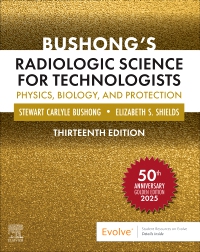

Bushong’s Radiologic Science for Technologists - Elsevier eBook on VitalSource, 13th Edition
Elsevier eBook on VitalSource
Now $117.91
Develop the skills you need to produce diagnostic-quality medical images! Bushong’s Radiologic Science for Technologists, 13th Edition, provides a solid foundation in the concepts of medical imaging and digital radiography. Featuring hundreds of radiographs and illustrations, this comprehensive text helps you learn how to make informed decisions regarding technical factors, image quality, and radiation safety for both patients and providers. With updates reflecting the latest ARRT® guidelines, including shielding practices and streamlined physics and math sections focused on key concepts, this edition equips you with the knowledge needed to succeed on the certification exam and excel in clinical settings.
-
-
 Sherpath for Bushong Radiologic Science for TechnologistsSherpath Book-Organized
 -

-
 Workbook for Radiologic Science for Technologists - Elsevier E-Book on VitalSourceElsevier eBook on VitalSource
 -

-
-
- NEW! Chapters on artificial intelligence and quantum computing help you stay abreast of key technological changes.
- NEW! Streamlined physics and math sections focus on the content you need to know to prepare for the ARRT exam, while also providing the background you need to perform well in the clinical environment
- UPDATED! Content reflects the latest ARRT guidelines, including the latest released shielding guidelines
- Broad coverage of radiologic science topics includes radiologic physics, imaging, radiobiology, and radiation protection. Special topics include mammography, fluoroscopy, spiral computed tomography, and cardiovascular interventional procedures
- Strong pedagogy, including objectives, key terms, outlines, chapter introductions, and summaries, helps you organize information and ensure that you understand what is most important in every chapter
- Quick-reference information, including formulas, conversion tables, abbreviations, and more, provides easy access to frequently used information
- End-of-chapter questions, such as definition exercises, short answer, and calculations, offer valuable review opportunities
- Key terms are bolded and defined at first mention in the text and are included in an expanded glossary to ensure you understand key terms as they are used in discussions of important concepts
- Math formulas are highlighted in special color boxes for quick reference
- Important concepts boxes are denoted with a penguin icon
- Evolve companion website provides answers to challenge questions, answers to workbook questions, an image collection, and review questions to reinforce your understanding of key content
-
PART I: RADIOLOGIC PHYSICS
1. Essential Concepts of Radiologic Science
2. Basic Physics Primer
3. The Structure of Matter
4. Electromagnetic Energy
5. Electricity, Magnetism, and Electromagnetism
PART II: X-RADIATION
6. The X-ray Imaging System
7. The X-ray Tube
8. X-ray Production
9. X-ray Emission
10. X-ray Interaction With Matter
PART III: X-RAY IMAGING
11. Computed Radiography
12. Digital Radiography
13. Digital Radiographic Technique
14. Image Acquisition
15. Scatter Radiation
16. Digital Image Descriptors and Evaluation
17. Radiographic Artifacts
PART IV: ADVANCED MEDICAL IMAGING
18. Mammography
19. Fluoroscopy
20. Interventional Radiology
21. Computed Tomography
22. Tomosynthesis
PART V: MEDICAL IMAGE DISPLAY
23. Patient-Image Optimization
24. Viewing the Medical Image
25. Medical Image Informatics
26. Digital Display Device
PART VI: THE MEDICAL IMAGE
27. Imaging Science
28. Artificial Intelligence
29. Quantum Computing
30. Image Perception
PART VII: RADIOBIOLOGY
31. Human Biology
32. Fundamental Principles of Radiobiology
33. Molecular Radiobiology
34. Cellular Radiobiology
35. Deterministic Effects of Radiation
36. Stochastic Effects of Radiation
PART VIII: RADIATION PROTECTION
37. Health Physics
38. Designing for Radiation Protection
39. Radiography/Fluoroscopy Patient Radiation Dose
40. Computed Tomography Patient Radiation Dose
41. Patient Radiation Dose Management
42. Occupational Radiation Dose Management -
-
Ways of Reading
- The appearance of the text and page layout can be modified according to the capabilities of the reading system (font family and font size, spaces between paragraphs, sentences, words, and letters, as well as color of background and text)
- This e-publication is accessible to the full extent that the file format and types of content allow, on a specific reading device, by default, without necessarily including any additions such as textual descriptions of images or enhanced navigation
- No information about nonvisual reading is available
-
Conformance
- For detailed accessibility information, see Elsevier's website at https://www-elsevier-com.ucc.idm.oclc.org/about/accessibility
- For queries regarding accessibility information, contact [email protected]
- The publication was certified on 18-11-2025
-
Navigation
- Table of contents to all chapters of the text via links
-
Rich Content
- No information is available
-
Hazards
- No information is available
-
Product Content
- No information is available
-
Legal Considerations
- No information is available
-
Additional Accessibility Information
- For readers with color vision deficiency, use of color (e.g., in diagrams, graphics and charts, in prompts, or on buttons inviting a response) is not the sole means of graphical distinction or of conveying information
- E-publication includes basic navigation (usually less detailed than TOC-based navigation)
- Where links, controls or buttons are included in the content, the purpose or functionality of each link, control or button is apparent from the associated text alone - or where it is unclear, separate link, control or button descriptions are provided
- All (or substantially all) textual matter is arranged in a single logical reading order (including text that is visually presented as separate from the main text flow, e.g., in boxouts, captions, tables, footnotes, endnotes, citations, etc.). Non-textual content is also linked from within this logical reading order. (Purely decorative non-text content can be ignored).
- The language of the text has been specified (e.g., via the HTML or XML lang attribute) to optimise text-to-speech (and other alternative renderings), both at the whole document level and, where appropriate, for individual words, phrases or passages in a different language.
-
Ways of Reading

 as described in our