
ISBN:
9780323765053
Copyright:
2023
Publication Date:
05-04-2022
Page Count:
528
Imprint:
Saunders
List Price:
$93.99

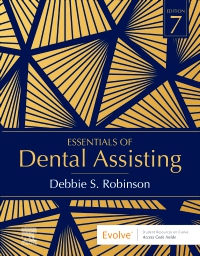
Essentials of Dental Assisting - Elsevier eBook on VitalSource, 7th Edition
by Debbie S. Robinson, CDA, MS
Elsevier eBook on VitalSource
ISBN:
9780323765053
Copyright:
2023
Publication Date:
05-04-2022
Page Count:
528
Imprint:
Saunders
List Price:
$93.99
Most review copies are eBooks – how fast!
A review copy request is most likely to be fulfilled as an eBook on VitalSource rather than a print product, unless no eBook is available. eBooks become available in as little as a few hours. Print products will take between 7 and 10 days to arrive. To request a print copy, please contact us through the Evolve Support Center for further assistance or contact your Elsevier Sales Rep.
Help your students master the core skills and knowledge needed to become a dental assistant! Essentials of Dental Assisting, 7th Edition provides concise, easy-to-understand guidelines for the basic and expanded functions performed by dental assistants. Illustrated, step-by-step procedures help students learn the dental assistant’s role and responsibilities, and application exercises help them develop critical thinking skills and solve problems. An Evolve website adds video clips demonstrating clinical skills, patient cases with interactive exercises, and practice questions for board exams. Ideal for shorter, accelerated DA programs, this practical resource will help your students become valuable members of any dental healthcare team.
-
- NEW! Expanded content updates information in areas such as the electronic health record, preventive techniques, the impact of the Affordable Care Act, and cultural diversity
- NEW! Updated photos and illustrations include vivid original renderings of head, neck, and dental anatomy, along with improved photos of the latest products, equipment, and instruments
-
- NEW! Expanded content updates information in areas such as the electronic health record, preventive techniques, the impact of the Affordable Care Act, and cultural diversity
- NEW! Updated photos and illustrations include vivid original renderings of head, neck, and dental anatomy, along with improved photos of the latest products, equipment, and instruments
- Comprehensive, easy-to-read coverage spans the entire dental assisting curriculum, with cutting-edge content providing essential knowledge and skills
- Step-by-step procedures are provided for basic and expanded dental assisting functions, showing techniques, the equipment and supplies needed, and the rationale behind each step, along with icons to identify the preparation and precautions
- Expanded Function procedures are identified with a distinctive EF icon and feature a different-colored background to differentiate them from basic procedures
- Multiple-choice review questions and Apply Your Knowledge questions are provided at the end of each chapter, allowing students to assess their comprehension and build problem-solving abilities
- Learning objectives in each chapter introduce the topics students will learn about, and Ethical Implications boxes bring a moral perspective to dental assisting issues
- Key terms and a complete glossary with definitions strengthen understanding of important terminology
- Evolve website supports student learning with video clips of key procedures, patient cases, quizzes and exams, and more
-
-
 Sherpath for Robinson: Essentials of Dental AssistingSherpath Book-Organized
 -
 Student Workbook for Essentials of Dental Assisting – Elsevier eBook on VitalSourceElsevier eBook on VitalSource
 -

-

-
-
PART 1: The Profession
1. Introduction to Dental Assisting
2. Professional and Legal Aspects of Dental Assisting
PART 2: The Sciences
3. Anatomy and Physiology
4. Dental Anatomy
PART 3: Infection Control in the Dental Setting
5. Microbiology and Disease Transmission
6. Management of Hazardous Materials
7. Surface Disinfection and Treatment Room Preparation
8. Instrument Processing
PART 4: Patient Care
9. The Dental Patient
10. Medical Emergencies in the Dental Office
PART 5: Foundation of Clinical Dentistry
11. Delivering Dental Care
12. Instruments, Handpieces, and Accessories
13. The Dental Exam
14. Moisture Control
15. Pain and Anxiety Management
PART 6: Dental Imaging
16. Radiation Safety and Production of X-Rays
17. Oral Radiography
PART 7: Dental Materials
18. Restorative and Esthetic Dental Materials
19. Impression Materials and Laboratory Procedures
PART 8: Preventive Dentistry
20. Preventive Care
21. Coronal Polishing and Dental Sealants
PART 9: Comprehensive Dentistry
22. Restorative Dentistry
23. Prosthodontics and Dental Implants
24. Periodontics
25. Endodontics
26. Oral and Maxillofacial Surgery
27. Pediatric Dentistry
28. Orthodontics
PART 10: Preparation for Employment
29. The Job Search
Glossary
Index -
-
Ways of Reading
- The appearance of the text and page layout can be modified according to the capabilities of the reading system (font family and font size, spaces between paragraphs, sentences, words, and letters, as well as color of background and text)
- This e-publication is accessible to the full extent that the file format and types of content allow, on a specific reading device, by default, without necessarily including any additions such as textual descriptions of images or enhanced navigation
- No information about nonvisual reading is available
-
Conformance
- For detailed accessibility information, see Elsevier's website at https://www-elsevier-com.ucc.idm.oclc.org/about/accessibility
- For queries regarding accessibility information, contact [email protected]
- The publication was certified on 18-11-2025
-
Navigation
- Table of contents to all chapters of the text via links
-
Rich Content
- No information is available
-
Hazards
- No information is available
-
Product Content
- No information is available
-
Legal Considerations
- No information is available
-
Additional Accessibility Information
- For readers with color vision deficiency, use of color (e.g., in diagrams, graphics and charts, in prompts, or on buttons inviting a response) is not the sole means of graphical distinction or of conveying information
- E-publication includes basic navigation (usually less detailed than TOC-based navigation)
- Where links, controls or buttons are included in the content, the purpose or functionality of each link, control or button is apparent from the associated text alone - or where it is unclear, separate link, control or button descriptions are provided
- All (or substantially all) textual matter is arranged in a single logical reading order (including text that is visually presented as separate from the main text flow, e.g., in boxouts, captions, tables, footnotes, endnotes, citations, etc.). Non-textual content is also linked from within this logical reading order. (Purely decorative non-text content can be ignored).
- The language of the text has been specified (e.g., via the HTML or XML lang attribute) to optimise text-to-speech (and other alternative renderings), both at the whole document level and, where appropriate, for individual words, phrases or passages in a different language.
-
Ways of Reading
Most review copies are eBooks – how fast!
A review copy request is most likely to be fulfilled as an eBook on VitalSource rather than a print product, unless no eBook is available. eBooks become available in as little as a few hours. Print products will take between 7 and 10 days to arrive. To request a print copy, please contact us through the Evolve Support Center for further assistance or contact your Elsevier Sales Rep.

 as described in our