
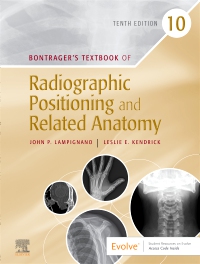

Bontrager's Textbook of Radiographic Positioning & Related Anatomy - Elsevier eBook on VitalSource, 10th Edition
Elsevier eBook on VitalSource
Now $187.43
Get the information and guidance you need to become proficient in positioning with Bontrager’s Textbook of Radiographic Positioning and Related Anatomy, 10th Edition. With a very easy-to-follow organization, this comprehensive text focuses on nearly 200 of the most commonly requested projections to ensure you master what’s expected of an entry-level practitioner. And with Bontrager’s user-friendly format featuring one projection per page — with bulleted information on the left side of the page and positioning photos, radiographic images, and anatomical drawings aligned on the right — you’ll be able to quickly and easily visualize anatomy and master positioning.
Newer Edition Available

Radiographic Positioning and Related Anatomy - Elsevier E-Book on VitalSource
-
- NEW! Updated photographs visually demonstrate the latest digital technology used in radiography with new radiographs, positioning, and equipment images.
- UPDATED! The latest ARRT competencies and ASRT curriculum guidelines are incorporated to prepare students for boards and clinical practice.
- NEW! Erect positions have been added throughout the text to reflect current practice.
- NEW! New Bernageau and Zanca projections have been included to keep students on top of these projections performed for shoulder pathology and trauma.
- UPDATED! Critique section at the end of chapters tests students’ understanding of common positioning and technical errors found in radiographs. Answer keys are provided for instructors on the Evolve website.
- UPDATED! Expanded content on fluoroscopy has been included to keep students up to date on the latest information.
-
- Labeled radiographs (radiographic overlays) identify key radiographic anatomy and landmarks to help students recognize anatomy and determine if they have captured the correct diagnostic information on images.
- Positioning chapters organized with one projection per page present a manageable amount of information in an easily accessible format.
- Unique page layout with positioning photos, radiographic images, and radiographic overlays is presented side-by-side with the text explanation of each procedure to facilitate comprehension and retention.
- Clinical Indications features list and define pathologies most likely to be encountered during procedures to help students understand the whole patient and improve their ability to produce radiographs that make diagnosis easy for the physician.
- Evaluation Criteria content on positioning pages describes the evaluation/critique process that should be completed for each radiographic image.
- Pediatric, Geriatric, and Bariatric Patient Considerations are provided to prepare technologists to accommodate unique patient needs.
- Emphasis on radiation safety practices provides recommendations important for clinical practice.
-
-
 Workbook for Bontrager's Textbook of Radiographic Positioning and Related Anatomy - Elsevier eBook on VitalSourceElsevier eBook on VitalSource
 -
 Bontrager's Handbook of Radiographic Positioning & Techniques - Elsevier eBook on VitalSourceElsevier eBook on VitalSource
 -

-

-
-
1. Terminology, Imaging, and Positioning Principles
2. Chest
3. Abdomen
4. Upper Limb
5. Humerus and Shoulder Girdle
6. Lower Limb
7. Femur and Pelvic Girdle
8. Cervical and Thoracic Spine
9. Lumbar Spine, Sacrum, and Coccyx
10. Bony Thorax—Sternum and Ribs
11. Cranium, Facial Bones, and Paranasal Sinuses
12. Biliary Tract and Upper Gastrointestinal System
13. Lower Gastrointestinal System
14. Urinary System and Venipuncture
15. Trauma, Mobile, and Surgical Radiography
16. Pediatric Radiography
17. Angiography and Interventional Procedures
18. Computed Tomography
19. Special Radiographic Procedures
20. Diagnostic and Therapeutic ModalitiesReferences
Additional Resources
Index -
-
Ways of Reading
- The appearance of the text and page layout can be modified according to the capabilities of the reading system (font family and font size, spaces between paragraphs, sentences, words, and letters, as well as color of background and text)
- This e-publication is accessible to the full extent that the file format and types of content allow, on a specific reading device, by default, without necessarily including any additions such as textual descriptions of images or enhanced navigation
- No information about nonvisual reading is available
-
Conformance
- No information is available
-
Navigation
- Table of contents to all chapters of the text via links
- Page list to go to pages from the print source version
-
Rich Content
- No information is available
-
Hazards
- No information is available
-
Product Content
- No information is available
-
Legal Considerations
- No information is available
-
Additional Accessibility Information
- Page breaks included from the original print source
- For readers with color vision deficiency, use of color (e.g., in diagrams, graphics and charts, in prompts, or on buttons inviting a response) is not the sole means of graphical distinction or of conveying information
- E-publication includes basic navigation (usually less detailed than TOC-based navigation)
- Where links, controls or buttons are included in the content, the purpose or functionality of each link, control or button is apparent from the associated text alone - or where it is unclear, separate link, control or button descriptions are provided
- All (or substantially all) textual matter is arranged in a single logical reading order (including text that is visually presented as separate from the main text flow, e.g., in boxouts, captions, tables, footnotes, endnotes, citations, etc.). Non-textual content is also linked from within this logical reading order. (Purely decorative non-text content can be ignored).
- The language of the text has been specified (e.g., via the HTML or XML lang attribute) to optimise text-to-speech (and other alternative renderings), both at the whole document level and, where appropriate, for individual words, phrases or passages in a different language.
-
Ways of Reading

 as described in our