
ISBN:
9780323681889
Copyright:
2021
Publication Date:
03-23-2020
Page Count:
160
Imprint:
Mosby
List Price:
$38.99

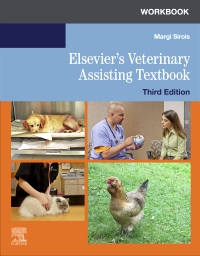
Workbook for Elsevier's Veterinary Assisting Textbook - Elsevier eBook on VitalSource, 3rd Edition
by Margi Sirois, EdD, MS, RVT, CVT, LAT, VTES
Elsevier eBook on VitalSource
ISBN:
9780323681889
Copyright:
2021
Publication Date:
03-23-2020
Page Count:
160
Imprint:
Mosby
List Price:
$38.99
Was
$38.99
Now $34.31
Or $0.00 with a valid access code
Reinforce your understanding of veterinary assisting! Corresponding to the chapters in Elsevier’s Veterinary Assisting Textbook, 3rd Edition, by Margi Sirois, this workbook provides activities and exercises for additional review and practice of the tasks performed by veterinary assistants. With challenging review questions, sample cases, and more, it’s an excellent way to master the material and prepare for success on the AVA exam and in the veterinary clinic.
Newer Edition Available

Workbook for Elsevier's Veterinary Assisting Textbook - Elsevier eBook on VitalSource
Elsevier eBook on VitalSource
ISBN: 9780443122781
-
- NEW! Updated activities and questions reflect the new content in Elsevier’s Veterinary Assisting Textbook, 3rd Edition.
-
- Learning activities reinforce the essential information in each chapter of the textbook, including review questions, short essays, illustration labeling, matching questions, fill-in-the-blank questions, true-or-false questions, multiple-choice questions, crossword puzzles, and word searches.
- Learning objectives in each chapter help you focus on the material and concepts that you are expected to learn and how to apply them in the clinical setting.
-
-
 Elsevier's Veterinary Assisting Textbook-Elsevier E-Book on VitalSourceElsevier eBook on VitalSource
-
-
1. Overview of the Veterinary Profession
2. Office Procedures and Client Relations
3. Medical Terminology
4. Animal Behavior and Restraint
5. Animal Husbandry and Nutrition
6. Animal Care and Nursing
7. Anatomy and Physiology
8. Pharmacology and Pharmacy
9. Anesthesia and Surgical Assisting
10. Laboratory Procedures
11. Diagnostic Imaging
12. Avian and Exotic Animal Care and Nursing
13. Large Animal Nursing and Husbandry -
-
Ways of Reading
- The appearance of the text and page layout can be modified according to the capabilities of the reading system (font family and font size, spaces between paragraphs, sentences, words, and letters, as well as color of background and text)
- This e-publication is accessible to the full extent that the file format and types of content allow, on a specific reading device, by default, without necessarily including any additions such as textual descriptions of images or enhanced navigation
- No information about nonvisual reading is available
-
Conformance
- No information is available
-
Navigation
- Table of contents to all chapters of the text via links
- Page list to go to pages from the print source version
-
Rich Content
- No information is available
-
Hazards
- No information is available
-
Product Content
- No information is available
-
Legal Considerations
- No information is available
-
Additional Accessibility Information
- Page breaks included from the original print source
- For readers with color vision deficiency, use of color (e.g., in diagrams, graphics and charts, in prompts, or on buttons inviting a response) is not the sole means of graphical distinction or of conveying information
- E-publication includes basic navigation (usually less detailed than TOC-based navigation)
- Where links, controls or buttons are included in the content, the purpose or functionality of each link, control or button is apparent from the associated text alone - or where it is unclear, separate link, control or button descriptions are provided
- All (or substantially all) textual matter is arranged in a single logical reading order (including text that is visually presented as separate from the main text flow, e.g., in boxouts, captions, tables, footnotes, endnotes, citations, etc.). Non-textual content is also linked from within this logical reading order. (Purely decorative non-text content can be ignored).
- The language of the text has been specified (e.g., via the HTML or XML lang attribute) to optimise text-to-speech (and other alternative renderings), both at the whole document level and, where appropriate, for individual words, phrases or passages in a different language.
-
Ways of Reading
Was
$38.99
Now $34.31
Or $0.00 with a valid access code

 as described in our