
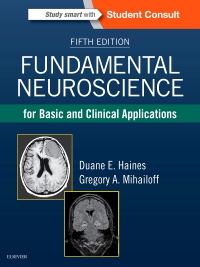

Fundamental Neuroscience for Basic and Clinical Applications - Elsevier eBook on VitalSource, 5th Edition
Elsevier eBook on VitalSource
Now $74.79
Using a rigorous yet clinically-focused approach, Fundamental Neuroscience for Basic and Clinical Applications, 5th Edition, covers the fundamental neuroscience information needed for coursework, exams, and beyond. It integrates neuroanatomy, pharmacology, and physiology, and offers a full section devoted to systems neurobiology, helping you comprehend and retain the complex material you need to know.
Newer Edition Available

Fundamental Neuroscience for Basic and Clinical Applications - Elsevier eBook on VitalSource
-
- Highlights clinical content in blue throughout the text, helping you focus on what you need to know in the clinical environment
-
Section I Essential Concepts
1. Orientation to the Structure and Imaging of the Central Nervous System
2. The Cell Biology of Neurons and Glia
3. The Electrochemical Basis of Nerve Function
4. Chemical Signaling in the Nervous System
5. Development of the Nervous System
Section II Regional Neurobiology
6. The Ventricles, Choroid Plexus, and Cerebrospinal Fluid
7. The Meninges
8. A Survey of the Cerebrovascular System
9. The Spinal Cord
10. An Overview of the Brainstem
11. The Medulla Oblongata
12. The Pons and Cerebellum
13. The Midbrain
14. A Synopsis of Cranial Nerves of the Brainstem
15. The Diencephalon
16. The Telencephalon
Section III Systems Neurobiology
17. The Somatosensory System I: Tactile Discrimination and Position Sense
18. The Somatosensory System II: Nociception, Thermal Sense, and Touch
19. Viscerosensory Pathways
20. The Visual System
21. The Auditory System
22. The Vestibular System
23. Olfaction and Taste
24. Motor System I: Peripheral Sensory, Brainstem, and Spinal Influence on Anterior Horn Neurons
25. Motor System II: Corticofugal Systems and the Control of Movement
26. The Basal Nuclei
27. The Cerebellum
28. Visual Motor Systems
29. Visceral Motor Pathways
30. The Hypothalamus
31. The Limbic System
32. The Cerebral Cortex
33. The Neurologic Examination -
-
Ways of Reading
- The appearance of the text and page layout can be modified according to the capabilities of the reading system (font family and font size, spaces between paragraphs, sentences, words, and letters, as well as color of background and text)
- This e-publication is accessible to the full extent that the file format and types of content allow, on a specific reading device, by default, without necessarily including any additions such as textual descriptions of images or enhanced navigation
- No information about nonvisual reading is available
-
Conformance
- No information is available
-
Navigation
- Table of contents to all chapters of the text via links
- Page list to go to pages from the print source version
-
Rich Content
- No information is available
-
Hazards
- No information is available
-
Product Content
- No information is available
-
Legal Considerations
- No information is available
-
Additional Accessibility Information
- Page breaks included from the original print source
- For readers with color vision deficiency, use of color (e.g., in diagrams, graphics and charts, in prompts, or on buttons inviting a response) is not the sole means of graphical distinction or of conveying information
- E-publication includes basic navigation (usually less detailed than TOC-based navigation)
- Where links, controls or buttons are included in the content, the purpose or functionality of each link, control or button is apparent from the associated text alone - or where it is unclear, separate link, control or button descriptions are provided
- All (or substantially all) textual matter is arranged in a single logical reading order (including text that is visually presented as separate from the main text flow, e.g., in boxouts, captions, tables, footnotes, endnotes, citations, etc.). Non-textual content is also linked from within this logical reading order. (Purely decorative non-text content can be ignored).
- The language of the text has been specified (e.g., via the HTML or XML lang attribute) to optimise text-to-speech (and other alternative renderings), both at the whole document level and, where appropriate, for individual words, phrases or passages in a different language.
-
Ways of Reading

 as described in our