
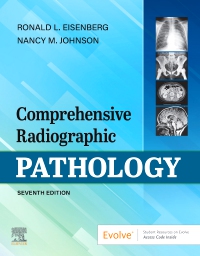

Comprehensive Radiographic Pathology Elsevier eBook on VitalSource, 7th Edition
Elsevier eBook on VitalSource
Give your students the perfect level of pathology coverage to help them consistently produce quality radiographic images with Comprehensive Radiographic Pathology, 7th Edition. This full-color text provides a foundation in the basic principles of pathology and then focuses on the radiographic appearances of diseases and injuries that are most likely to be diagnosed with medical imaging. Understanding these disease processes, the radiographic appearances, and the treatments is necessary for technologists to fully contribute to the functioning of the diagnostic team, and Eisenberg’s 7th edition is the perfect resource to ground students in all three of these areas. Enhancements to this new edition include updated images in all modalities, content aligned to the latest ARRT Guidelines, updated Radiographer Notes, and the inclusion of some pediatric pathologies.
Newer Edition Available

Comprehensive Radiographic Pathology Elsevier eBook on VitalSource
-
- NEW! Updated images in all modalities provides the important information needed for clinical success.
- NEW! Updated content matches the latest ARRT Guidelines to assist you in preparing for boards.
- NEW! Updated Radiographer Notes incorporate current digital imaging information for both computed radiography and direct digital capture.
- NEW! Inclusion of certain pediatric pathologies expands your comfort level with child and adolescent patients.
-
- NEW! Updated images in all modalities provides the important information that students need for clinical success.
- NEW! Updated content matches the latest ARRT Guidelines to assist students in preparing for boards.
- NEW! Updated Radiographer Notes incorporate current digital imaging information for both computed radiography and direct digital capture.
- NEW! Inclusion of certain pediatric pathologies expands students’ comfort level with child and adolescent patients.
- Thorough explanations help students select proper modalities and producing optimal images.
- Hundreds of high-quality illustrations covering all modalities clearly demonstrate clinical manifestations of different disease processes and provide a standard for the high-quality images needed in radiography practice.
- Discussion of specialized imaging explains how supplemental modalities, such as ultrasound, computed tomography, magnetic resonance imaging, nuclear medicine, single-photon emission computed tomography (SPECT), and positron emission tomography (PET) are sometimes needed to diagnose various pathologies.
- Brief explanations of likely treatments provide valuable background.
- Systems-based approach for building an understanding of pathology makes it easy for students to locate information and study one area at a time.
-
-
 Workbook for Comprehensive Radiographic Pathology Elsevier eBook on VitalSourceElsevier eBook on VitalSource
 -

-
 Workbook for Comprehensive Radiographic Pathology Elsevier eBook on VitalSourceElsevier eBook on VitalSource
 -

-
-
1. Introduction to Pathology
2. Specialized Imaging Techniques
3. Respiratory System
4. Skeletal System
5. Gastrointestinal System
6. Urinary System
7. Cardiovascular System
8. Nervous System Disease
9. Hematopoietic System
10. Endocrine System
11. Reproductive System
12. Miscellaneous Diseases
Answers to Review Questions
Appendix A Prefixes/Suffixes/Roots
Appendix B Laboratory Tests
Glossary -
-
Ways of Reading
- The appearance of the text and page layout can be modified according to the capabilities of the reading system (font family and font size, spaces between paragraphs, sentences, words, and letters, as well as color of background and text)
- This e-publication is accessible to the full extent that the file format and types of content allow, on a specific reading device, by default, without necessarily including any additions such as textual descriptions of images or enhanced navigation
- No information about nonvisual reading is available
-
Conformance
- No information is available
-
Navigation
- Table of contents to all chapters of the text via links
- Page list to go to pages from the print source version
-
Rich Content
- No information is available
-
Hazards
- No information is available
-
Product Content
- No information is available
-
Legal Considerations
- No information is available
-
Additional Accessibility Information
- Page breaks included from the original print source
- For readers with color vision deficiency, use of color (e.g., in diagrams, graphics and charts, in prompts, or on buttons inviting a response) is not the sole means of graphical distinction or of conveying information
- E-publication includes basic navigation (usually less detailed than TOC-based navigation)
- Where links, controls or buttons are included in the content, the purpose or functionality of each link, control or button is apparent from the associated text alone - or where it is unclear, separate link, control or button descriptions are provided
- All (or substantially all) textual matter is arranged in a single logical reading order (including text that is visually presented as separate from the main text flow, e.g., in boxouts, captions, tables, footnotes, endnotes, citations, etc.). Non-textual content is also linked from within this logical reading order. (Purely decorative non-text content can be ignored).
- The language of the text has been specified (e.g., via the HTML or XML lang attribute) to optimise text-to-speech (and other alternative renderings), both at the whole document level and, where appropriate, for individual words, phrases or passages in a different language.
-
Ways of Reading

 as described in our